
Technical Architecture
Built for Scale, Designed for Integration
OpenELIS Global is built on a modern, fully open-source technology stack designed for national-scale laboratory networks. Standards-based interoperability, containerized deployment, and enterprise-grade security make it the foundation for digital laboratory transformation.
System Overview
Enterprise Architecture
OpenELIS Global follows a layered architecture pattern with clear separation between presentation, application, and data tiers—enabling independent scaling and simplified maintenance.
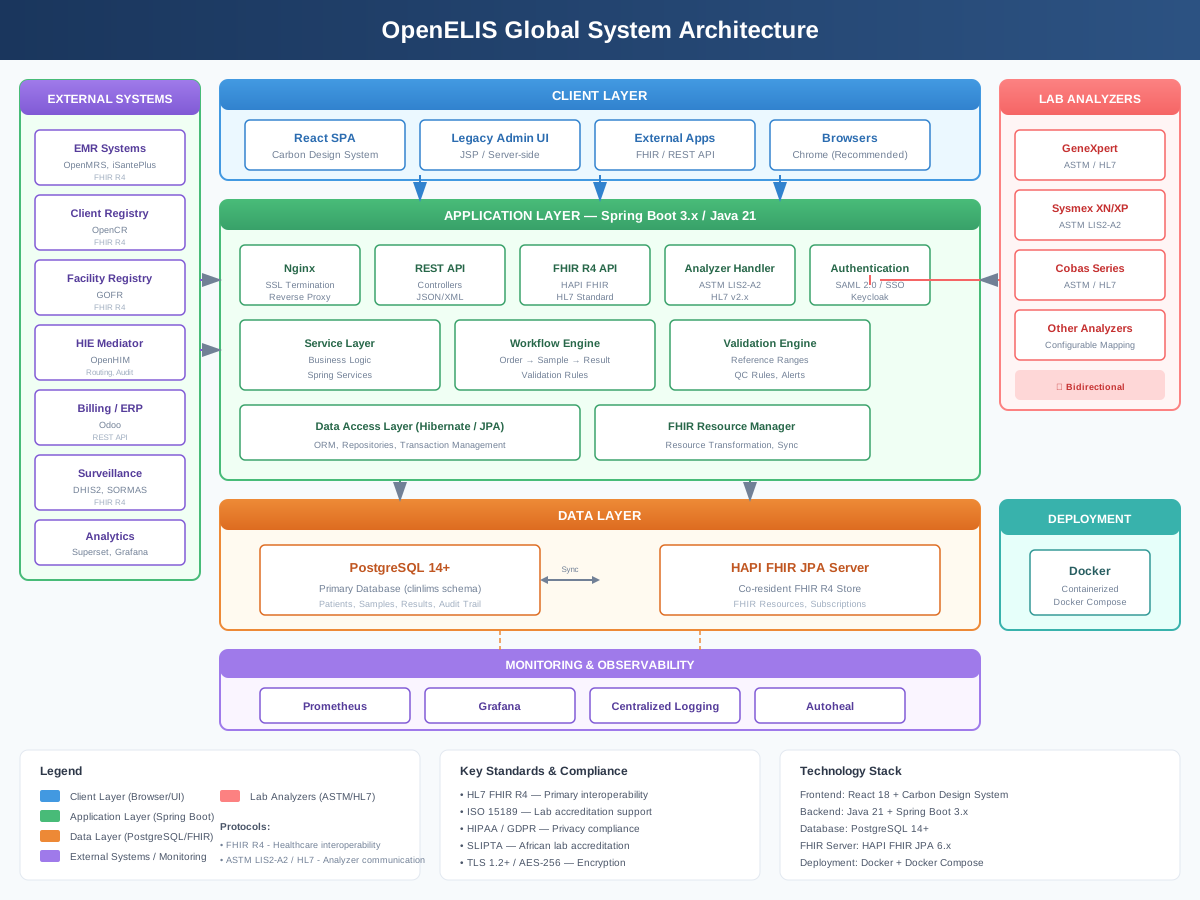
OpenELIS Global system architecture showing client layer, application services, data stores, external integrations, and monitoring infrastructure.
Modern Three-Tier Architecture
A clean separation of concerns enables independent development, testing, and scaling of each layer while maintaining loose coupling through well-defined interfaces.
Client Layer
The modern React single-page application provides a responsive, accessible interface built on IBM’s Carbon Design System. A legacy JSP-based admin UI remains available for specific administrative functions during the ongoing modernization effort.
Main laboratory interface with Carbon Design System
React 18
IBM’s accessible, enterprise-grade component library
v11
Works on tablets, laptops, and desktop workstations
Application Layer
Spring Boot powers the backend with a RESTful API architecture. The application layer handles business logic, workflow orchestration, and data validation while exposing both internal REST endpoints and FHIR-compliant interfaces.
Enterprise Java framework with dependency injection
3.x / Java 21
Reference FHIR server implementation
6.x
JSON-based API for frontend and integrations
Data Layer
PostgreSQL provides the primary relational data store with proven scalability for millions of lab records. An embedded HAPI FHIR JPA server maintains a parallel FHIR representation for interoperability.
Primary relational database
14+
HAPI JPA-based FHIR resource storage
📖 Learn More
For detailed architecture documentation, database schemas, and contribution guidelines, visit the OpenELIS Global Technical Wiki.
Native HL7 FHIR R4 Interoperability
OpenELIS Global implements the most comprehensive FHIR R4 integration among open-source laboratory systems, with published Implementation Guides and active participation in the OpenHIE LIS Community of Practice.
Supported FHIR Resources
The laboratory workflow is fully modeled using standard FHIR R4 resources, enabling seamless data exchange with any FHIR-capable system.
ServiceRequest
DiagnosticReport
Observation
Specimen
Patient
Practitioner
Encounter
Organization
Location
Lab Order Workflow
The order-to-result workflow follows OpenHIE patterns using Task-based orchestration:
- EMR creates
ServiceRequest+Taskwith status requested - OpenELIS receives Task, imports patient, creates internal order
- Lab processes specimen, enters results
- OpenELIS updates Task status, creates
DiagnosticReport+Observation - EMR receives completed results via subscription or polling
FHIR Implementation Guide
A formal FHIR Implementation Guide documents all profiles, extensions, and constraints specific to OpenELIS Global.
Published IG with profiles, examples, and validation rules
FSH definitions and build configuration for the Implementation Guide
🌍 OpenHIE Alignment
OpenELIS Global follows OpenHIE architectural patterns and actively participates in the LIS Community of Practice, ensuring alignment with global health information exchange standards.
Flexible Integration Options
Connect OpenELIS Global to your health information ecosystem using standards-based APIs and proven integration patterns.
Integration Endpoints
| Endpoint | Protocol | Use Case |
|---|---|---|
| /fhir/* | FHIR R4 | EMR integration, national data exchange |
| /api/* | REST | Internal frontend, custom integrations |
| TCP Socket | ASTM | Laboratory analyzer communication |
| TCP/MLLP | HL7 v2 | Legacy analyzer interfaces |
Supported External Systems
OpenMRS, iSantePlus, Bahmni
OpenCR, SantéMPI
GOFR, mCSD
OpenHIM
Odoo
DHIS2, SORMAS
Example: EMR Integration
Receiving a lab order from an EMR system:
{
  "resourceType": "ServiceRequest",
  "status": "active",
  "intent": "order",
  "code": {
    "coding": [{
      "system": "http://loinc.org",
      "code": "22748-8",
      "display": "LDL Cholesterol"
    }]
  },
  "subject": {
    "reference": "Patient/123"
  }
}# Enable FHIR subscription listener
org.openelisglobal.fhir.subscriber.resources=\
Task,Patient,ServiceRequest,\
DiagnosticReport,Observation,Specimen📖 Integration Guide
Step-by-step integration tutorials are available in the technical documentation, including OpenMRS setup guides.
Flexible Deployment for Any Environment
From single-site installations to national laboratory networks, OpenELIS Global’s containerized architecture adapts to your infrastructure requirements.
Docker Compose
Production-ready containerized deployment with all dependencies pre-configured.
- Single command deployment
- All services containerized
- Persistent data volumes
- Automatic SSL/TLS
- Built-in backup scripts
- Autoheal container recovery
Cloud Deployment
Deploy on AWS, Azure, or GCP using managed container services.
- Kubernetes / ECS compatible
- Managed database options
- Auto-scaling capabilities
- Geographic redundancy
- Disaster recovery built-in
Traditional Server
Direct deployment on Ubuntu Server for environments without container support.
- WAR deployment to Tomcat
- System PostgreSQL database
- Manual service management
- Lower resource requirements
Consolidated Server
National-scale deployment with centralized data aggregation and analytics.
- Multi-site data federation
- FHIR data warehouse
- National dashboards
- OpenHIM mediation
- Analytics pipeline
# Clone the deployment repository
git clone https://github.com/I-TECH-UW/openelis-docker.git
cd openelis-docker

# Start OpenELIS Global
docker-compose up -d

# Access at https://localhost
Bidirectional Analyzer Communication
Connect laboratory instruments using industry-standard protocols. Visual configuration tools eliminate the need for custom development when adding new analyzers.
Supported Protocols
| Protocol | Direction | Common Analyzers |
|---|---|---|
| ASTM LIS2-A2 | Bidirectional | Most modern analyzers |
| HL7 v2.x | Bidirectional | Hospital analyzers, some POC |
| Serial / RS-232 | Varies | Older instruments |
| File-based | Import only | CSV/TXT export analyzers |
Pre-Configured Analyzers
Ready-to-use mappings for common laboratory instruments:
Sysmex
Cobas
Abbott
Beckman Coulter
BD BACTEC
FACSCANTO
QuantStudio
Configuration Process
- Define Connection: Configure IP address, port, and protocol type in Admin settings
- Map Test Codes: Use the visual mapping interface to link analyzer test codes to OpenELIS tests
- Configure Fields: Map result fields, units, and flags from the analyzer message format
- Test Connection: Send test queries and verify bidirectional communication
- Go Live: Enable the interface for production use
🔌 Adding New Analyzers
New analyzers that follow ASTM or HL7 standards can typically be configured in hours, not weeks—without any code changes. Contact the community for help with unusual instruments.
Enterprise-Grade Security
OpenELIS Global implements defense-in-depth security with authentication, authorization, encryption, and comprehensive audit logging.
Authentication
Keycloak integration with OAuth2/OIDC, SAML 2.0, and LDAP/AD support. Multi-factor authentication available.
Role-Based Access Control
Granular permissions by role and lab unit. Data segregation ensures users only access authorized information.
Encryption
TLS 1.2+ for all data in transit. AES-256 encryption available for data at rest. Certificate management built-in.
Audit Logging
Every action logged with timestamp, user ID, and details. Immutable audit trail meets regulatory requirements.
Penetration Tested
Regular security assessments and code scanning. Certified for deployment on high-security government networks.
Compliance Ready
Configurable for HIPAA, GDPR, ISO 27001, and national data protection regulations.
🔐 Why Single Sign-On Matters
Keycloak integration enables centralized identity management across your entire health information ecosystem. Laboratory staff authenticate once and gain secure access to OpenELIS, EMR systems, and other connected applications—eliminating password fatigue while strengthening security. For ministries of health, this means seamless integration with existing Active Directory or government identity providers, simplified user provisioning across hundreds of facilities, and a single point of control for access policies and audit trails. When a staff member leaves or changes roles, access is revoked instantly across all systems from one central location.
National Scale
Health Information Exchange Architecture
OpenELIS Global is designed to operate as part of a national health information exchange, following OpenHIE architectural patterns for scalable, interoperable laboratory networks.
Resources
Documentation & Community
Everything you need to evaluate, deploy, and customize OpenELIS Global.
Technical Wiki
Architecture deep-dives, API documentation, and developer guides on Confluence.
FHIR Implementation Guide
Published profiles, examples, and validation for FHIR R4 integration.
Community Forum
Connect with implementers, ask questions, and share experiences.
Product Roadmap
See what’s coming next and provide input on future development priorities.
Product Stewardship
Backed by World-Class Health Informatics Expertise
OpenELIS Global is stewarded by the Digital Initiatives Group (DIGI) at the University of Washington—a premier health informatics resource center with over 15 years of experience delivering digital health systems worldwide.
DIGI’s multidisciplinary team of human-centered designers, full-stack engineers, implementation specialists, and researchers has supported health systems serving over 18.7 million patients across 26+ countries. Their mission centers on “designing from the margins”—putting the expertise and lived experiences of end users at the forefront of system development.
Whether you’re a ministry of health planning a national laboratory network, a hospital system seeking to modernize operations, or an NGO implementing lab services in resource-limited settings, DIGI’s team is available to partner on:
End-to-end deployment from planning through go-live and beyond
Feature extensions and integrations tailored to your workflows
Interoperability design for national health information exchanges
Workforce development and informatics leadership strengthening

🎓 University-Backed, Community-Driven
As part of the University of Washington, DIGI brings academic rigor, research capabilities, and a commitment to open-source principles. OpenELIS Global benefits from this foundation while remaining freely available to the global health community.
Ready to Get Started?
Whether you’re evaluating OpenELIS for a new project or ready to deploy, our community is here to help.